Editor’s Note
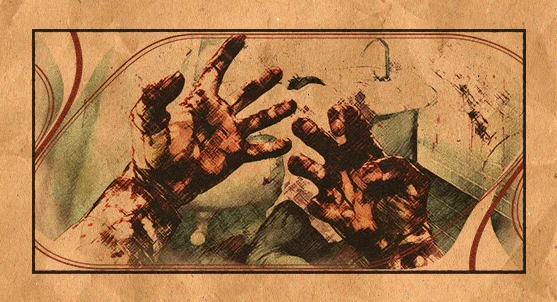
Renowned restauranteur and food critic Marianne de Chaguerre—in a typically scathing review—recounted the time she caused a chef to slip with a knife and lose three fingers into the soup of the day. Apparently it was the most intoxicating meal she’d had in years. Some tastes, however, may lead a person to a quite different place. See where this culinary adventure began in Delicious is the Tongue of the Taster Part One, before reading the conclusion to “The Curious Case of the Missing Critic and His Editor”…
Delicious is the Tongue of the Taster –
Part Two
Mr. Morgan,
E. S. Leisure Ways
Howard,
I write to you one final time from the Excelsior, though this room that once seemed so grand feels smaller now, and somehow dimmer. I have no tales of sumptuous repasts to regale you with in this missive; indeed, I do not believe I ate today at all beyond a middling scone and some weak tea from amongst the hotel’s Continental breakfast offerings. The Excelsior may have a reputation for lavishness, and The Black Goat may well serve meals that would put the finest New York City restaurants to shame, but the only thing “Continental” about their breakfast was its similarity to the bland, boring cuisine of the British.
Though in truth, I am not at all certain my stomach would have tolerated anything richer after a sleepless night spent tossing and turning in sweat-soaked sheets as I tried in vain not to think of Velma’s delicious, bloody… but, no. I will not even write of it, for where the pen goes, the mind has no recourse but to follow.
After breaking my fast in this sad fashion, I dressed and determined that a brisk constitutional in the bright New England sunshine would be the cure for whatever ailed me. A quick query of the Hotel Manager, Mr. Hilary Riley-Wurts, saw me on my way to Independence Square, the beating heart of downtown Arkham.
The square was cheerfully green, filled with couples strolling along the stone paths and families picnicking under the shade of birch trees while their children ran about laughing and calling to one another, playing whatever games it is children are wont to play these days. A baseball diamond and horseshoe pitch were bustling with adults similarly calling to one another, though they were playing games with which I was much more familiar.
At the center of the square loomed a large gray stone, which Mr. Riley-Wurts had informed me was known as Founder’s Rock. As I approached, I could see a bronze plaque inscribed with the date of the town’s foundation and a roll of its founding citizens. There was even a Morgan amongst the names, though I do not recall you ever mentioning that you had family here. Curious.
Nearby were a pavilion and a bandstand, the latter advertising the evening’s entertainment, a string quartet with the clever moniker “Arkham’s Arcadian Orchestra.” Off to the south was an empty bocce court and, surprisingly, what looked to be a caravan.
I felt strangely drawn to it, in a way disturbingly reminiscent of the compulsion that had first set my feet on this journey from the Big Apple to this odd duck of a town. Once I got closer, I noticed a woman sitting on a blanket in the shadow of the caravan. She was watching me intently, deftly shuffling an oversized deck of cards as I moved closer.
I could not tell you now what she looked like or was wearing or even how young or old she might have been. But I recall with crystal clarity the words she spoke to me.
“Welcome, weary traveler. Come, sit. Let Anna Kaslow read the cards for you and give you the answers you hunger for.”
Normally such an offer would hold no temptation for me, Howard, as you well know—I am not much given to fancy, florid prose and the elusive taste that began this quest notwithstanding. But somehow in that moment I could no more refuse her overture than I could choose not to breathe.
So I sat where she indicated on the blanket, cut the cards when she held them out to me, then watched with mounting trepidation as she peeled three placards off the top and placed them face down in front of me.
She touched the first card.
“The past,” she said, and turned it over. “The Nine of Swords, upright.”
It depicted a figure sitting up in bed at night, face in hands, as if awaking from a terrible dream. Nine swords crossed the space horizontally behind the person—man or woman, it was impossible to say—with the lower few swords almost giving the illusion of having pierced the heart, the throat, and the top of the figure’s head.
“You have been plagued by nightmares,” Ms. Kaslow intoned.
I confess, I was tempted then to laugh in her face, get up, and walk away without so much as a backward glance. First her comments about being a “weary traveler,” and now this. Any charlatan could surmise I was a traveler, given that I was not a regular at the park. My bloodshot eyes and exhausted sigh as I sat would have tipped any halfway decent con artist off that I hadn’t been sleeping well, and nightmares were part and parcel with that complaint.
But her next words kept me rooted in place, and even had fire rained from the heavens, I am not certain that I would have been able to move until she released me from the husky spell of her voice.
“Worse than the dreams, though, is the memory that haunts you, that buzzes about your consciousness like a mosquito, alighting only briefly to suck the life like blood from you, bit by bit, with you powerless to stop it, because you cannot confront what you refuse to remember.”
Before I could ask her what she meant by that cryptic comment, she flipped over the next card.
“Your present. The Devil, reversed.”
This card showed what looked to be a variation of Eliphas Levi’s “Baphomet” perched on a pedestal or altar, with naked male and female demons chained before it.
“You have buried your darkest, most taboo appetites so deeply that they are hidden even from your own waking mind. But buried does not mean dead, forgotten, or impotent. Especially not in Arkham.”
Scarcely had I begun to digest those words when she flipped the final card over.
“Your future. The Tower, upright.”
The card bore a tower at the top of a high cliff, in flames, being struck by lightning. Two figures were falling through the air from its heights, one seeming to bear a golden crown, though I suppose it might have been longish blond hair. That one looked a bit like you, Howard, and the other could have been me, if one squinted hard enough.
“Your path ends here, in disastrous revelation.” She looked up at me then, with something like pity in her eyes. “I am sorry.”
Then she hurriedly gathered the cards back up into the deck and stood, waiting impatiently for me to do the same before snatching her blanket up from the grass without bothering to fold it. She turned as if to rush off, and I reached out to grab her, demanding she explain to me what it all meant.
She wrenched her arm away and looked over her shoulder. The pity had now been joined by something colder that made my skin crawl.
“Come back tonight, after the concert, when the park has emptied of people. Then you will meet a man, and all will become clear.”
I wanted to ask more questions, of course, but she was already disappearing into the caravan, and I could not follow. I returned to the Excelsior and have penned this letter to you, Howard. And now I sit and wait in sick anticipation for night to fall, in the hope that I will learn what it is I have been chasing across the length of the Miskatonic Valley once and for all.
Pray for me.
Reggie
Mr. Howard J. Morgan, Sr.
c/o Empire State Leisure Ways,
Manhattan,
New York
Dear Mr. Morgan,
I am writing to inform you that an associate of yours, one Mr. Reginald Paul Gilmore, voluntarily checked himself into Arkham’s Sanatorium a week ago after claiming to have murdered someone, though he would not share details of this supposed crime. He has since been admitted to the catatonics wing, having become completely unresponsive. He remains under my watchful care and now spends his days, one imagines, staring into the Abyss.
However, before he slipped into this listless state, he penned a letter addressed to you, which I am including herein, still sealed. As Mr. Gilmore did not arrange payment in advance for indefinite care, which it now appears he will need, I am also including an estimate for those services.
Should you have any questions, please do not hesitate to contact the hospital.
Warmest Regards,
Dr. Adam Mintz, M.D.
Howie,
Oh, God, I understand everything now, and it’s the stuff of madness and torment.
I went back to the square after sundown, though I wish to God I had not. I don’t believe I had a choice. I don’t even remember leaving the hotel.
I went around to the south side of the park, expecting to find Ms. Kaslow and her mysterious man with all the answers, but neither she nor her caravan where anywhere in evidence. In fact, there was no one to be seen; the square and surrounding streets were empty of people, and the park itself was far darker than the waxing moon overhead ought to have allowed.
Unaccountably disappointed, I turned and began trudging across the square toward the hotel, heedless of the gloom that should have been a warning to turn back—one of many I realized only belatedly that I had ignored. But there was no turning back now, if there ever truly had been.
I passed by Founder’s Rock, unmindful of the darkness, ruminating over the reading I had gotten earlier in the day and what it could possibly mean. Wondering if I would ever know, or ever find what I was seeking.
Thus preoccupied, I nearly stumbled over a raggedy vagrant sitting in the middle of the path on several outspread squares of newspaper like a makeshift picnic blanket. The man was apparently engaged in his own midnight version of the daytime recreation favored by his more well-off neighbors. He grunted at my apology and wordlessly held out half of the sandwich he was eating.
I am not in the habit of taking food from the mouths of those less fortunate than myself, or of considerably inferior hygiene, but my stomach overrode both my principals and my squeamishness, growling fiercely and reminding me my last meal had been a paltry breakfast more than twelve hours past. Before I knew what I was doing, I had snatched the sandwich from his outstretched hand and torn off a bite, chewing and swallowing with unseemly relish.
And, oh, Howie, it was by turns smoky and sweet, meaty and succulent, and altogether delicious, and it filled me simultaneously with desire and absolute dread. For I knew this was, at long last, the flavor I had come so far to recapture, and I was starting to remember where I had first tasted it.
“Is this pork?” I asked the man around another helpless mouthful, and he laughed.
“Might could’ve been a swine. They usually are.”
I’d finished my half of the sandwich by then, unceremoniously wiping my mouth with the back of my hand in lieu of a napkin and wishing there was an unchurlish way I could ask the poor man for what remained of his half of the sandwich. For an instant, I even considered wresting it away from him! God help me.
Then his response truly registered.
“What do you mean, ‘a swine?’” I asked, thinking it an odd way to describe a pig raised for the slaughter.
He laughed again, and not pleasantly.
“Well, he’d hardly have been made into longpig if he’d been a saint, now would he?”
“He?” I asked, both my knees and voice going weak with alarm.
Somehow, his grinning teeth, the few that remained, gleamed in the meager moonlight able to pierce the murk, and a chill like death ran through me.
“You know, Reggie. You’ve known since you fled New York. It’s why you came on this journey. He’s why.”
“He?” I asked again, my mouth gone dry as ash.
Because I knew. I knew and wished to God I didn’t.
The vagrant nodded, no doubt seeing understanding dawn, if not by the color draining from my face, then by the wild terror that must surely have been making my eyes bulge.
“Yes, that’s right, Reggie. The man who questioned your relevance, said your palate had grown pedestrian and your prose trite, claimed you’d never truly been friends. Right before he fired you from your magazine column, your one claim to industry fame.
“Right before you made a meal out of him.”
Oh, Howie, I remember it all now, and I am so very sorry.
He was talking about you.
I have been writing you these letters all this time, but you will never read them, for you are dead.
And I am damned to hell for all eternity.
R.
Howard Morgan’s moldering corpse was found in his high-rise apartment after neighbors began to complain of a terrible odor emanating from within the residence. Remains of a dinner for two were in evidence—a professional affair, as opposed to a romantic one, judging by the cigar stubs, though who the other party to the meal might have been, the authorities could never determine.
As for the body itself, it was found half-eaten, a state attributed by said authorities to the rats that plague even the posh buildings in the city. We would note that rare indeed is the rat that uses a knife, fork, and napkin to enjoy its food, and rarer still the one that bothers to fry a bit of its meal up on the stove, but perhaps the less said about that, the better. We will leave that, Dear Reader, for you to decide.
—The Editors
Marsheila Rockwell