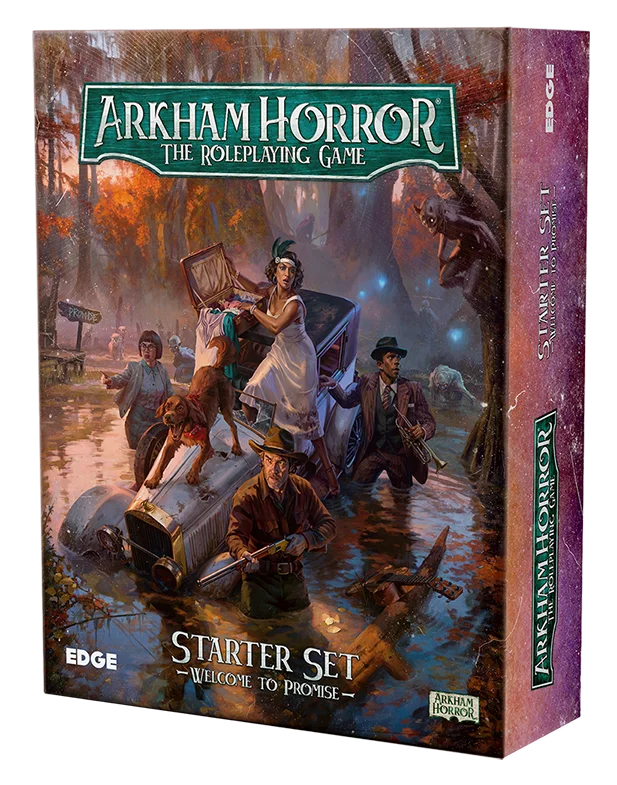
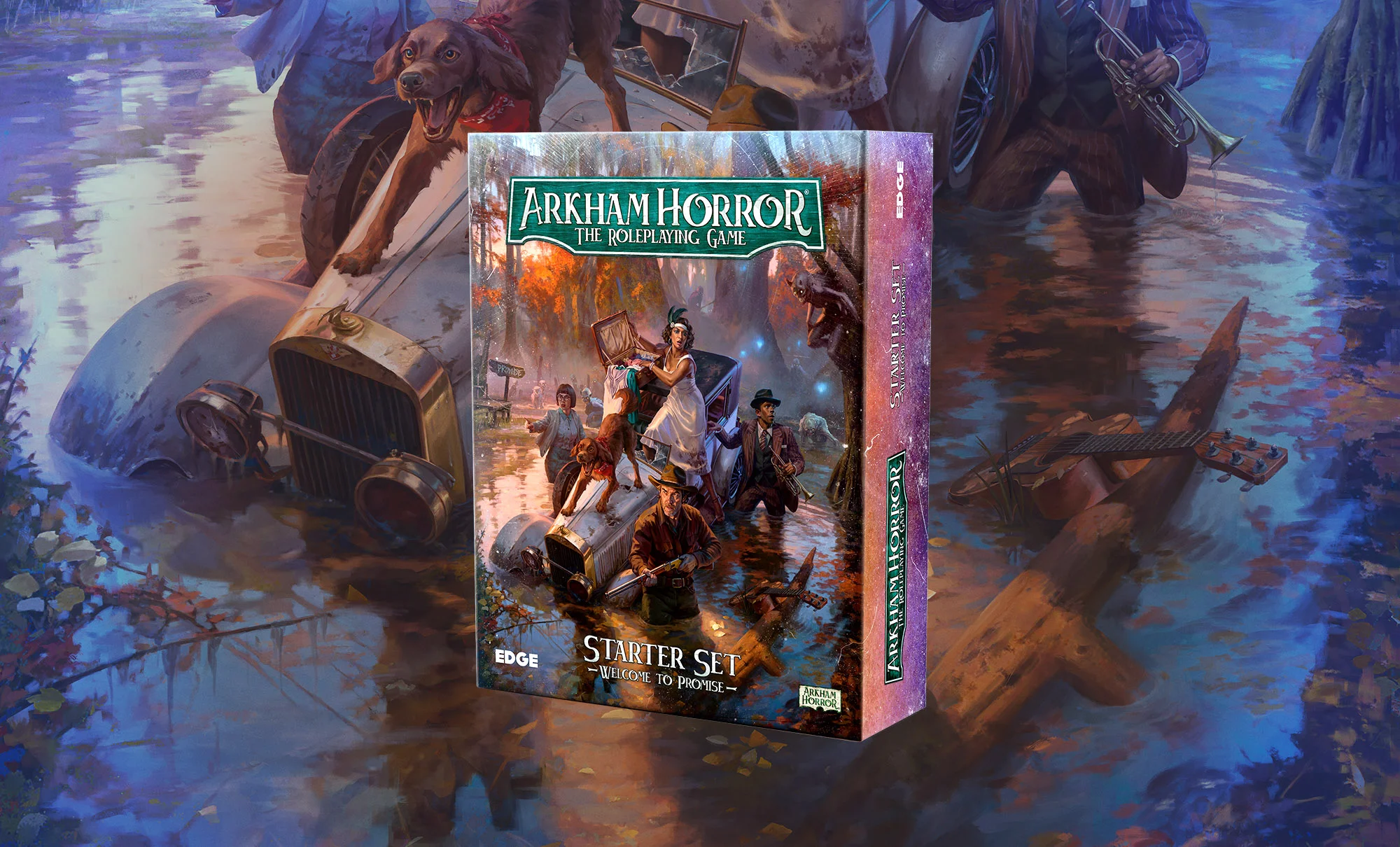
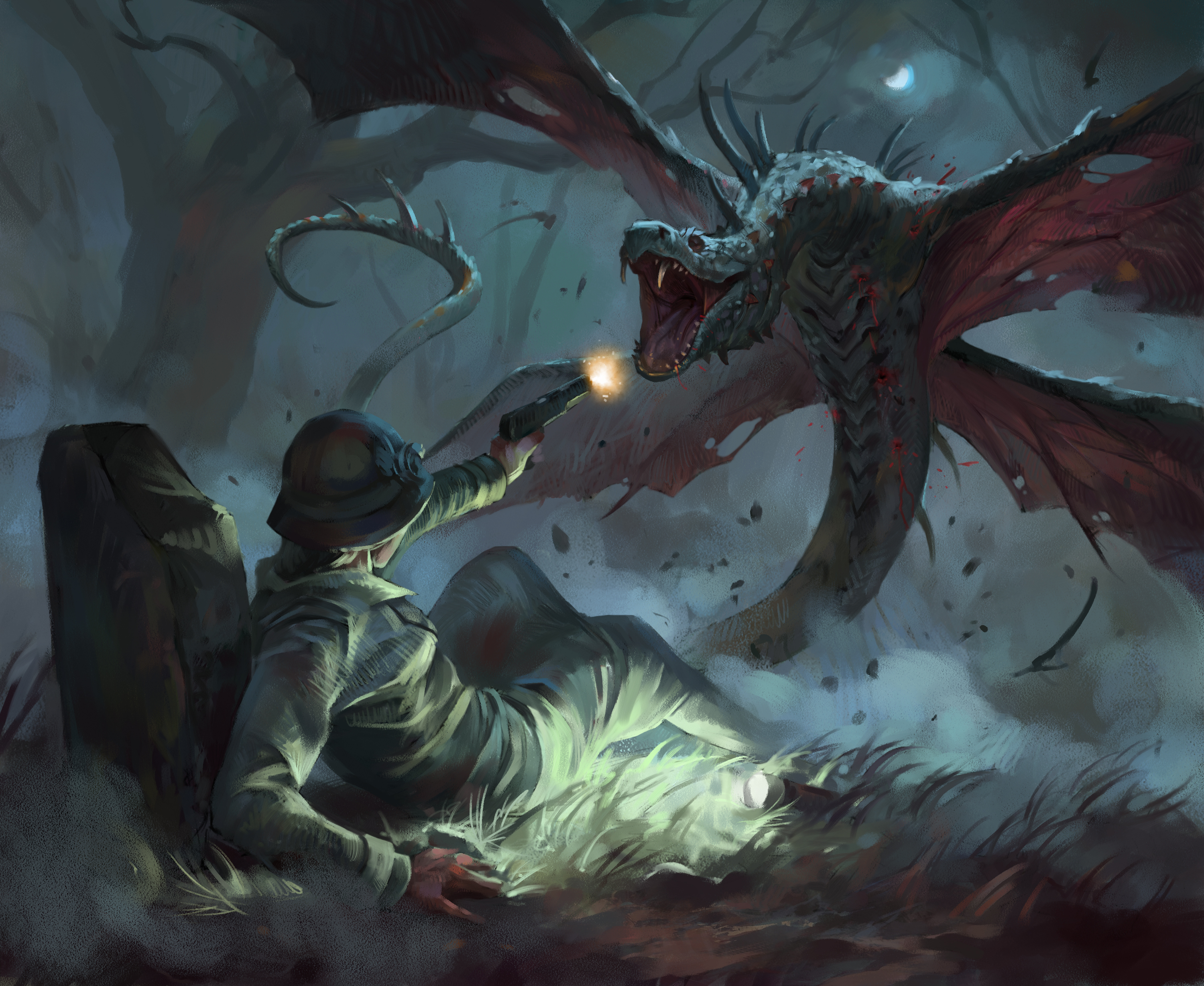
This week, the previews continue for Welcome to Promise, the upcoming starter set for Arkham Horror: The Roleplaying Game from Edge Studio. The project’s Lead Developer, Leah Hawthorne, discusses what goes into creating a starter set in Part One of this two-part interview:
Bonjour, investigators! Once again, it’s Keith Ryan Kappel, one of Edge Studio’s freelance game writers. Today I’m feeling finer than frog hair as it is my great pleasure to interview the great Leah Hawthorne about the production of the Welcome to Promise starter set for Arkham Horror: The Roleplaying Game. Leah served as the primary writer and developer on the project, with help from Christopher Hunt.
In the event you’ve been lost chasing Feux Follets in the bayou, and this is the first you’ve heard tell of a new starter set for Arkham Horror: The Roleplaying Game, allow me to catch you up. We announced Welcome to Promise earlier this year and later explored the contents included in the box in some detail.
With all that behind us, I know you have questions enough to fill a gumbo pot. So, let’s get some answers straight from the source!
Keith Ryan Kappel (KRK): So, Leah, congratulations on Welcome to Promise, and also, welcome to this interview! I’ve had the opportunity to read through the new starter set and it’s not just a wild ride of an adventure, it’s also a really great introduction to the system for new players and game masters. Of course, perhaps the most exciting bit is that it all takes place in 1920’s Louisiana.
How exciting was it to move the mythos out of the cold New England region and explore such a culturaland environmentally distinct place?
Leah B. Hawthorne(LBH): Hi Keith! Thank you so much, I know Chris and I really appreciate it. I’ll say that I was very, very excited to go south with this latest starter set. Louisiana has such an interesting history, and many of the different parishes and cultural groups have their own folklore that was pretty fun to research and explore. It’s funny, I feel like 80% of the research for various regions and products won’t end up getting used, but that 20% that does get used usually comes from digging into one topic to the next from a totally random starting point. It’s one of my favorite parts of writing—having the opportunity to deep-dive into different places and learn a bunch of random fun facts and tidbits. It makes for a great ice–breaker at parties, ha! I loved looking into cryptids, Louisianan voodoo, Creole and Cajun culture, local wildlife and, I admit, learning the differences between bayous, swamps, bogs, and marshes!
KRK: I was really impressed with how well the adventure balances a great story with teaching the rules, and how quickly you’re able to get new game masters and players into gameplay. Of course, I remembered that this isn’t the first starter set for the Arkham Horror: The Roleplaying Game — there’s also the Hungering Abyss starter set.
What motivated you and Edge Studio to produce a second starter set for a relatively young game line? What separates this starter set from Hungering Abyss?
LBH: There are a lot of factors that go into deciding what products to make, and from the beginning of the RPG’s development, we knew we wanted to create multiple entry points for players. It’s a move to appeal to new players and game masters, but it’s also another way for us to offer stories to existing players, too. Just because this is a starter set doesn’t mean the story itself isn’t a cool experience you can use with your existing campaign or with seasoned players.
We also wanted to take what we learned with Hungering Abyss and make changes based on what we saw could be improved and what we were hearing from fans. I tend to lurk in various forums and keep an ear out for what people are struggling with, and I’ve tried to take that information and make adjustments to improve player and game master experiences. We might not always get it perfect, but the folks at Edge are always trying to innovate and create quality products.
I won’t try to list everything that’s different, but a few highlights are a larger adventure booklet so we could include more content and possibilities in the narrative. I also revamped the teaching element of this box versus how I approached it in the first starter set, breaking the learn-to-teach into three segments with the big highlights, each leading into a scene to apply that new knowledge, and included references to additional information in the new rules appendix.
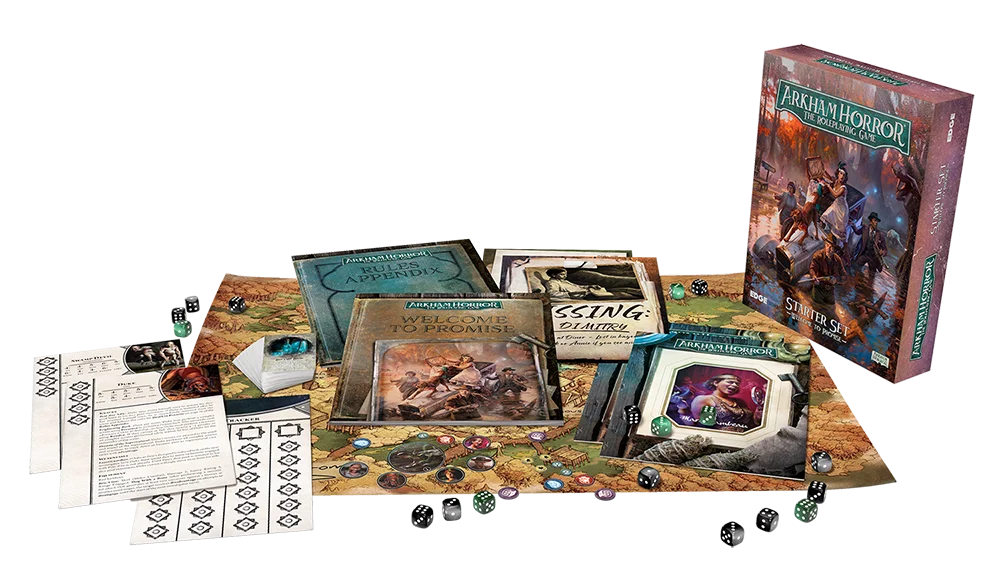
The rules appendix is a 16-page booklet gives a run-down of the rules of the game, can help answer any questions that come up in play in a more intuitive way than trying to flip through the adventure booklet frantically. We also wanted to create this rules appendix so GMs could use it across their games, increasing the value of this starter set for GMs even if they aren’t interested in this specific story. We tried to do that with various components this time around, including some injury and trauma reminder cards, new dice-tracker sheets for tracking multiple NPC dice pools simultaneously, and Pool Die tokens to track available dice in a player’s or NPC’s dice pool when there aren’t enough physical dice available.
KRK: This starter set is packed full of accessories. It has gorgeous maps, handy weapon and equipment cards, fearsome and friendly NPC cards, and great quick-reference sheets for rules and injuries and clues and more.
When you’re creating all these accessories, do you find it’s difficult to narrow the choices down? What makes for a good battle map? How do you fit a whole interesting character on a single NPC card?
LBH: Woah, a few rapid-fire questions there that all deserve their own answers. When we’re looking at what components to include in a box, it’s definitely a lot of back and forth. There’s obviously the production end where we ask, “What is possible?” and “If we include this, will it force us to change how much we charge for the product?” I can’t go into details about any of that, but there is a lot of discussion for all of our products across all of our lines about everything from the amount of pages we can include in a book to what we can include in a box.
Then you have the other important questions, “How does this additional serve the game master and player?” and “Does this make things easier, cooler, or more immersive?” and weighing all of the options. You wouldn’t think adding 16 pages to a book or adding 10 more NPC cards would be that big of a deal, but we have to think about the weight of the products for shipping, whether there is a minimum number of cards we’d have to add (if the printer has minimum requirements) and if we have useful, cool content to fill all of those cards.
From the development side, I always want to add more. My editorial manager, Croc (who is also one of the founders of asmodee and has been working on RPGs for 40+ years), always tells us to think big and bold, and then it’s his job to hash things out with production to see what is possible. I think it boils down to: what’s possible, what’s cool, what’s useful, and what’s required?
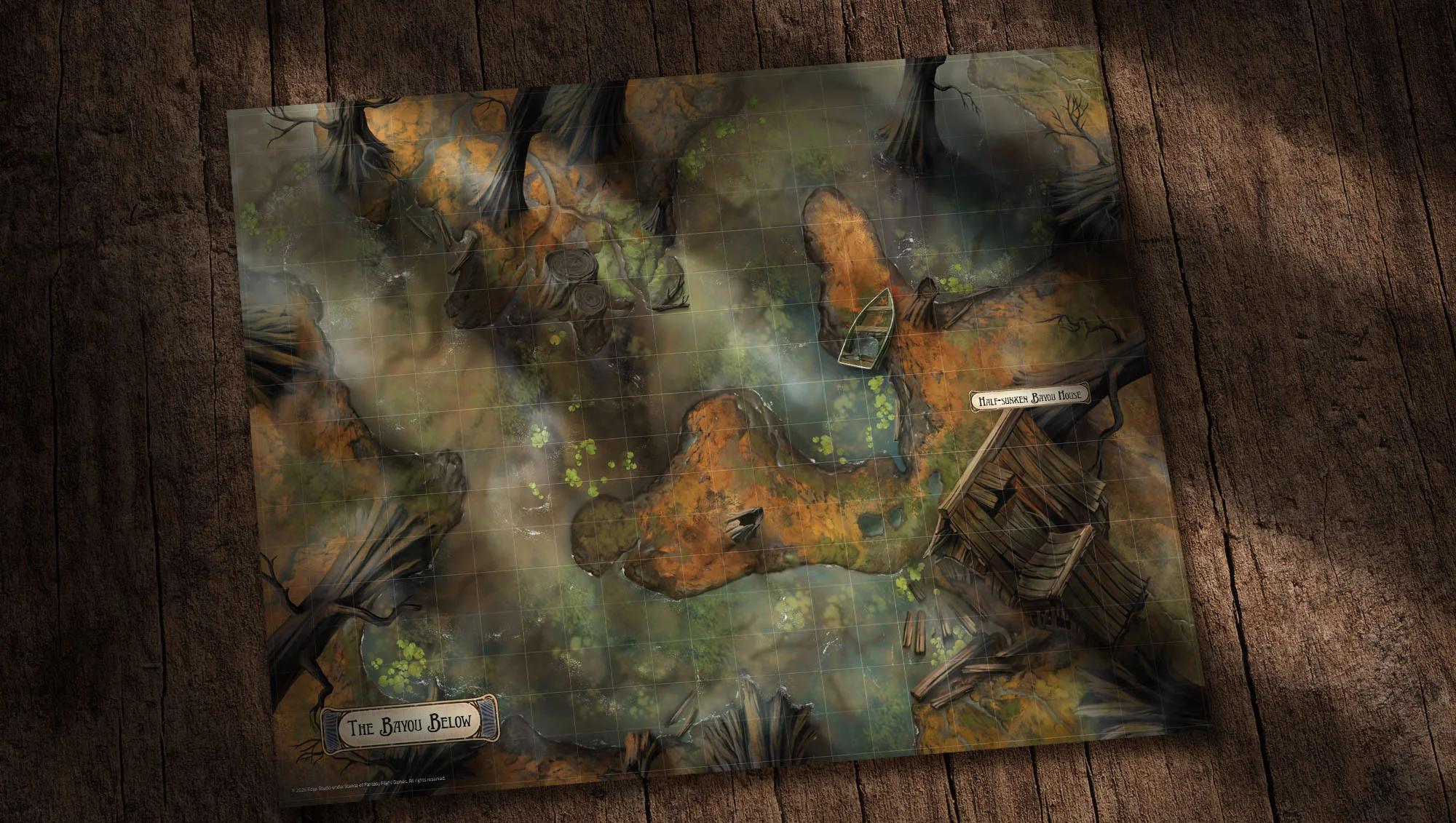
What makes a good battle map—great question. The answer is different depending on who you ask. For a game master, they need different aspects of the environment to work with in conjunction with the NPCs they’ll be using in that space. For players, they’ll want something that can spark roleplay ideas (like a sink in a warehouse, now the player has the idea to get a bucket of water to use against the enemy who is vulnerable to water).
In the early maps we made, some of the measurements surely ended up being a little wonky. We’ve tried to create both more general spaces that can be used across multiple scenarios, and also make sure each battle map has a good amount of flavor. In a future article, Antonio Maínez Venegas, our art director, talks a bit about the illustration process in general, which might be interesting to folks!
How do we create a whole interesting character on a single NPC card? That’s something we try to work on for each NPC. It helps that we can include information in the adventure booklet, too, of course. For some NPCs, like named ally characters, we include a backstory on one side with the aim to give the game master a good feeling of the personality and background of the individual. The art is also really important, and a good amount of work goes into writing art briefs/descriptions and working with our art director, Antonio Maínez Venegas, to get the characters looking right. A picture really says a lot.
I also try to name knacks, weaknesses, and even weapons in a flavorful way to give the game master more to work with. The knacks and weaknesses are super important to infuse with the personality of the character while keeping in mind what other NPCs might be in the scene.
Be sure to tune in later this week for the second part of our interview with Leah Hawthorne and Keith Ryan Kappel on ArkhamHorror.com. And don’t forget to pre-order your copy of Welcome to Promise before its release on July 31!
Explore the Paris of the South in Songs of New Orleans
As the nights grow longer and days grow colder, plan a vacation to the greatest city in the American South! Songs of New Orleans comes out on October 30th, and within its pages you’ll find the most comprehensive and terrifying guide to the Big Easy and the horrors that lurk within. Songs of New Orleans […]
This past weekend saw Gen Con, North America’s largest tabletop gaming convention, wrap up for another year, and the four days of the show in Indianapolis brought a host of announcements, awards, and other happenings in the world of Arkham Horror. In case you missed any of it, we present this round-up. Opening the Vault […]
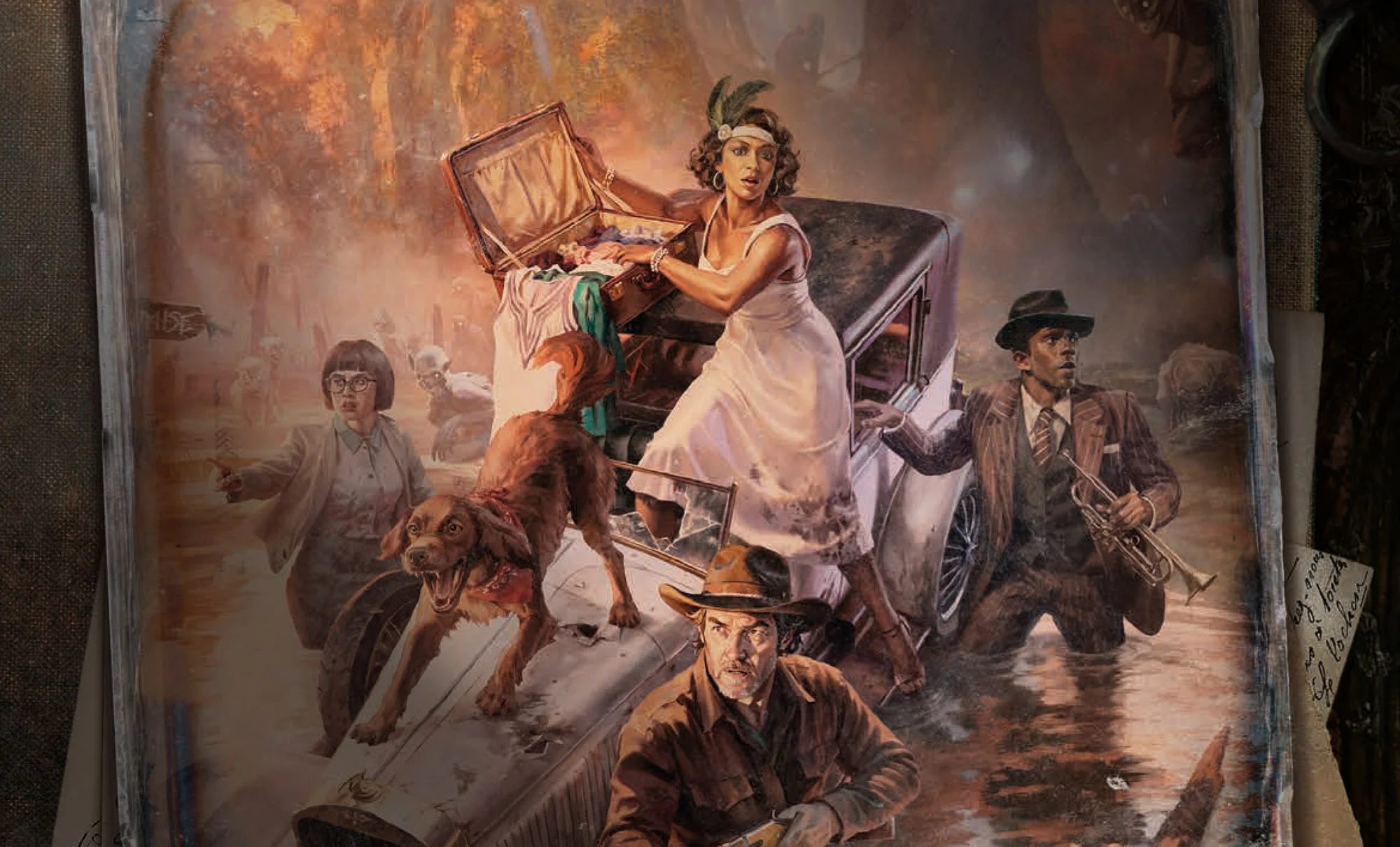
In the heart of rural Louisiana at the height of the 1920s, five intrepid investigators wake to find their memories foggy and injuries they can’t explain. They quickly discover that they are trapped in a supernatural town plagued by bizarre creatures and malicious spirits, and that the only way out is to use their wits, […]
Explore the Paris of the South in Songs of New Orleans
As the nights grow longer and days grow colder, plan a vacation to the greatest city in the American South! Songs of New Orleans comes out on October 30th, and within its pages you’ll find the most comprehensive and terrifying guide to the Big Easy and the horrors that lurk within. Songs of New Orleans […]
This past weekend saw Gen Con, North America’s largest tabletop gaming convention, wrap up for another year, and the four days of the show in Indianapolis brought a host of announcements, awards, and other happenings in the world of Arkham Horror. In case you missed any of it, we present this round-up. Opening the Vault […]
In the heart of rural Louisiana at the height of the 1920s, five intrepid investigators wake to find their memories foggy and injuries they can’t explain. They quickly discover that they are trapped in a supernatural town plagued by bizarre creatures and malicious spirits, and that the only way out is to use their wits, […]